
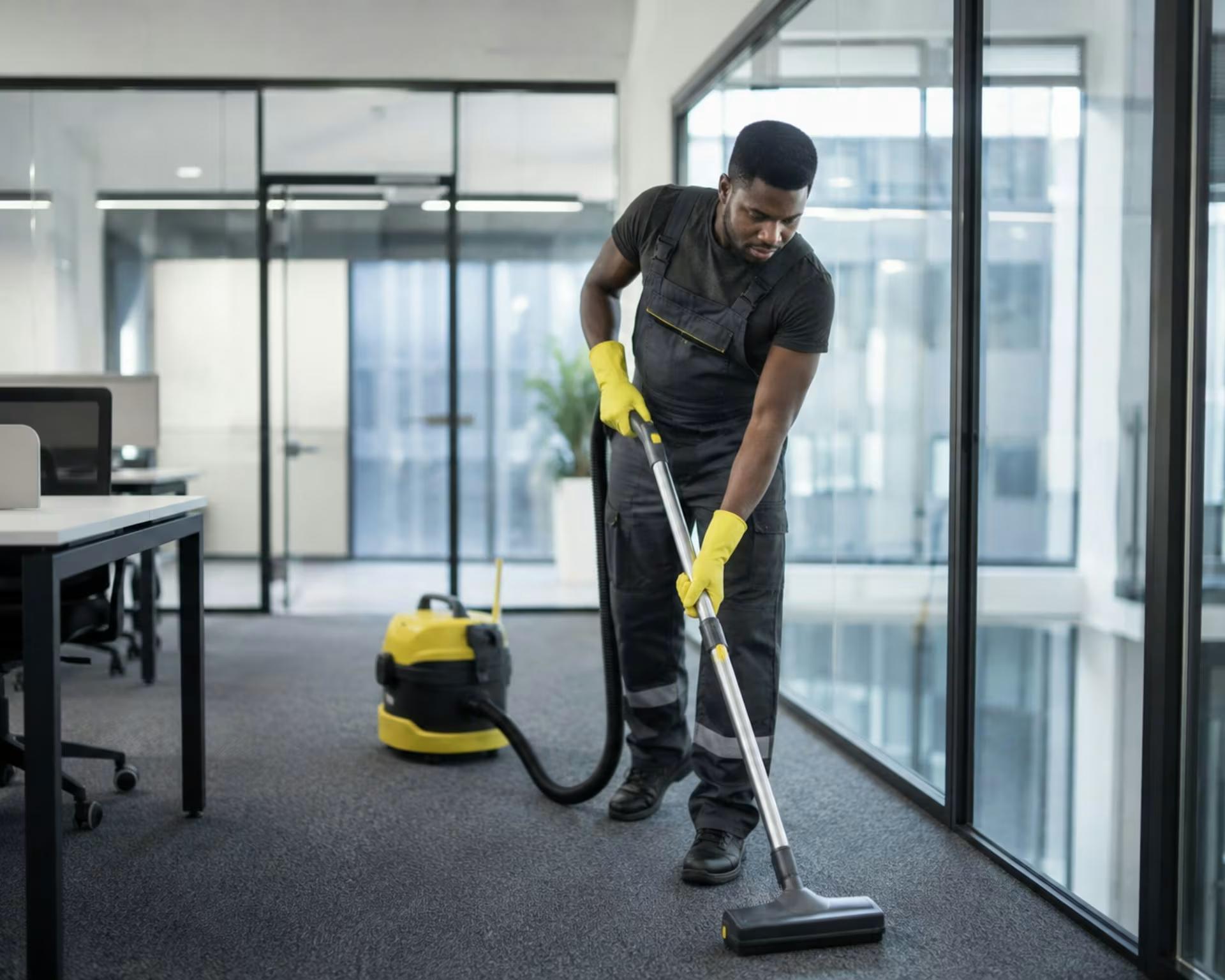
Your office carpet is holding more than foot traffic. In a workplace of 40 people, it's collecting skin cells, food debris, outdoor soil, and whatever the courier tracked in — every single day. Yet most offices book a vacuum-and-bins service and assume that's "cleaning."
It isn't. And the gap between surface cleaning and actual hygiene is where sick days, musty meeting rooms, and prematurely dead carpet come from.
This guide breaks down what office cleaning services actually include, which tasks belong on a daily versus quarterly schedule, what you should expect to pay in Australia, and the questions that separate a professional operator from a bloke with a vacuum.
What Are Office Cleaning Services?
Office cleaning services are recurring, contracted cleaning programs for commercial workspaces — covering daily janitorial tasks (bins, desks, bathrooms, floors) plus scheduled deep-cleaning work like carpet steam cleaning, tile and grout restoration, and upholstery treatment. Most offices combine a frequent light clean with a less frequent deep clean.
That two-tier structure matters, because the two tiers do completely different jobs:
- Janitorial (maintenance) cleaning keeps the office presentable: emptying bins, wiping surfaces, vacuuming, cleaning bathrooms and kitchens. Daily or several times a week.
- Deep (restorative) cleaning removes what maintenance cleaning can't reach: soil embedded in carpet pile, grime in grout lines, oils and odours in fabric chairs. Quarterly to annually, done by specialists with extraction equipment.
Vacuuming is the classic example of the gap. A commercial vacuum lifts dry surface debris, but it doesn't touch the fine soil that works its way down into the carpet pile and grinds against the fibres like sandpaper every time someone walks over it. That embedded grit — not age — is what makes high-traffic carpet look grey and worn in walkways while it still looks fine under desks. Only hot water extraction (steam cleaning) or low-moisture deep cleaning pulls it out.
The Core Services, Task by Task
| Service | What it covers | Typical frequency |
|---|---|---|
| General janitorial | Bins, desks, kitchens, bathrooms, spot vacuuming | Daily – 3×/week |
| Hard floor care | Mopping, buffing, sealing vinyl/timber/polished concrete | Weekly + periodic |
| Carpet steam cleaning | Hot water extraction of embedded soil, stains, allergens | Quarterly – biannually |
| Low-moisture carpet cleaning | Encapsulation clean; carpet dry and walkable in ~1–2 hours | Between steam cleans |
| Tile & grout cleaning | Pressurised cleaning and resealing of grout lines | Annually |
| Upholstery & fabric care | Office chairs, meeting room seating, fabric partitions | Annually – biannually |
| Odour & sanitisation treatment | Enzyme/antimicrobial treatment for persistent odours | As needed |
| Window & glass cleaning | Internal partitions, external glazing | Monthly – quarterly |
Three of these deserve a closer look, because they're the ones offices most often skip — and most often regret skipping.
Carpet cleaning: steam vs low-moisture
Hot water extraction is the deepest clean available for commercial carpet: heated solution is injected into the pile and immediately extracted along with the dissolved soil. The trade-off is drying time — typically several hours — which is why it's usually booked for a Friday evening or weekend.
Low-moisture (encapsulation) cleaning is the operational workaround. It uses a polymer solution that crystallises around soil particles, which are then vacuumed away. Carpet is walkable in an hour or two, making it viable mid-week without disrupting staff. It doesn't extract as deeply as steam, so the smart program alternates: steam clean quarterly or biannually, low-moisture maintenance in between.
Carpet manufacturers themselves back this cadence — most commercial carpet warranties require periodic hot water extraction by a trained professional to remain valid, with the IICRC S100 standard being the industry reference for frequency and method. [Suggested source: IICRC S100 Standard for Professional Cleaning of Textile Floor Coverings]
Tile and grout: the kitchen-and-bathroom problem
Grout is porous. Mopping pushes dirty water across it, and the grout drinks it in — which is why office kitchen grout lines go from grey to black even in offices that mop nightly. Professional grout cleaning uses pressurised hot water and alkaline cleaners to flush the lines, followed by a penetrating sealer that buys you 12+ months before it needs doing again. If your grout has been dark for years, expect the first clean to be dramatic and the maintenance cleans to be cheap.
Upholstery: the forgotten hygiene surface
Office chairs get eight hours of direct body contact a day and are almost never cleaned. Fabric task chairs absorb skin oils, sweat, and food spills, and they're a common source of the "stale office" smell no one can locate. Fabric-appropriate extraction cleaning once a year handles it — and matters double if you've moved to hot-desking, where chairs are shared.
How Often Should an Office Be Cleaned?
There's no single right schedule — it scales with headcount, foot traffic, and floor type. Use this as a starting matrix:
| Office profile | Janitorial | Carpet deep clean | Tile & grout | Upholstery |
|---|---|---|---|---|
| Small (under ~20 staff) | 2–3×/week | Every 6–12 months | Annually | Annually |
| Medium (20–80 staff) | Daily | Every 6 months | Annually | Annually |
| High-traffic (client-facing, 80+ staff, medical/hospitali ty) | Daily + day porter | Quarterly | 6–12 months | 6 months |
Two adjustments worth making:
- Weather exposure — Melbourne offices with street-level entries take a beating in winter — wet shoes carry fine clay soil that binds to carpet fibre. If your entry and lift-lobby carpet darkens noticeably between cleans, shorten the carpet interval rather than the janitorial one.
- Allergies and air quality — Carpet acts as a sink for dust and allergens; that's fine while they're trapped, but foot traffic re-suspends them. If staff report hay-fever-like symptoms indoors, deep-clean the carpet and check the HVAC filters before blaming the plants. [Suggested source: Australian Government "Indoor air" guidance, health.gov.au]
What Do Office Cleaning Services Cost in Australia?
Pricing models vary, but you'll generally see three structures:
- Hourly rate — common for janitorial contracts. Typical Australian commercial rates run roughly $35–$60 per hour depending on city, scope, and whether it's daytime or after-hours work.
- Per-square-metre — standard for carpet, tile, and hard-floor deep cleaning. Commercial carpet steam cleaning commonly ranges $3–$8 per m², with minimum call-out fees applying to small jobs.
- Fixed contract — a monthly fee covering an agreed scope and frequency. Best value for offices with predictable needs; make sure periodic deep cleaning is either included or scheduled separately, because many janitorial contracts quietly exclude it.
The most common budgeting mistake we see is treating deep cleaning as an optional extra rather than a line item. Commercial carpet replacement costs many times more per square metre than a decade of professional cleaning — deferred maintenance doesn't save money, it just moves the invoice to the fit-out budget.
7 Questions to Ask Before You Hire a Cleaner
A quote tells you the price. These questions tell you what you're actually buying:
- What's included in "carpet cleaning"? If the answer is "vacuuming," it's not carpet cleaning. Ask specifically about hot water extraction or encapsulation.
- What chemicals do you use, and are they safe for occupied workplaces? Non-toxic, low-VOC products matter in offices where staff return hours after the clean. Under Australian WHS law, businesses have a duty to manage chemical risks in the workplace, so this isn't just a preference question. [Suggested source: Safe Work Australia — managing risks of hazardous chemicals]
- Are your technicians trained/certified for carpet and fabric work? IICRC certification is the recognised benchmark for restorative cleaning.
- What's your drying time, and can you work after-hours? A cleaner who can't answer this hasn't done much commercial work.
- Are you insured for commercial premises? Public liability cover is non-negotiable; ask for the certificate.
- How do you handle stains you can't remove? Honest operators will tell you upfront that some stains (bleach spots, old dye stains) are permanent. Beware anyone who guarantees everything.
- Do you offer a satisfaction guarantee? A re-clean guarantee shifts the quality risk off you.
Key Takeaways
- Office cleaning is two programs, not one: frequent janitorial cleaning plus scheduled deep cleaning of carpet, grout, and upholstery. Skipping the second tier is what makes offices look tired.
- Vacuuming maintains; extraction restores. Embedded soil is abrasive and shortens carpet life — deep clean quarterly to biannually depending on traffic.
- Match the schedule to the office, not to a generic calendar: headcount, entries, weather exposure, and shared seating all move the intervals.
- Interrogate quotes. Method, chemicals, certification, insurance, and guarantee tell you more than the price does.
————
Ready to give your office floors a proper clean? Ozzy Carpet Cleaning provides commercial carpet steam cleaning, low-moisture cleaning, tile and grout restoration, and upholstery care across Melbourne, Geelong, Ballarat, and surround — using non-toxic products that are safe for your team, backed by a 100% satisfaction guarantee. Call 40-685-2749 or email info@ozzycarpetcleaning.com for a free commercial quote.
For professional help with office cleaning services: what they include, what they cost, and how often you actually need them, call our friendly team today.
Call Us: 0406 852 749